
Plainfield Criminal History Checks
Choose the record that can answer the question. Plainfield Police reports describe reported events and officer action. Municipal court records track city-level complaints. Union County jail data describes current local custody. PROMIS/Gavel tracks indictable Superior Court cases. A subject reviewing their own New Jersey criminal history uses the fingerprint-based NJSP Personal Record Request.
- Confirm that Plainfield Police, rather than NJSP, county police, or a neighboring agency, created the incident.
- Send a focused OPRA request to the city for the report or other identified police record.
- Use Municipal Court Case Search for a Plainfield complaint or ticket that stayed local.
- Check Union County custody and PROMIS/Gavel after an indictable arrest goes through prosecutor screening.
- Use NJSP and IdentoGO for a fingerprint-linked review of your own statewide history.
Record each incident, complaint, ticket, indictment, and SBI number found. Comparing those identifiers is safer than treating a matching name as proof that separate results concern the same person.
Plainfield Police Record Requests
The Plainfield Police Division is headquartered at 200 East Fourth Street, Plainfield, NJ 07060. The Division is the starting custodian for police reports, arrest narratives, incident video, and related city law-enforcement material that its officers created. Use the official police and city OPRA pages to confirm the current Records Bureau telephone, email, and counter hours.
Plainfield Police Division
200 East Fourth Street
Plainfield, NJ 07060
Official police directory
Verify current Records Bureau hours online.
Give the incident date, location, number, involved names, and exact item sought. Ask for an existing report, complaint, video, arrest sheet, or other identified record. A custodian may redact victim data, active investigative details, security material, or protected personal information. A denial should identify the legal basis while releasing any reasonably separable public part.
Records at the Plainfield Police Department
A Plainfield police file can include the reported allegation, witness details, location, officer response, probable-cause material, and references to evidence. It is not the same as a judgment. Even if a complaint is dismissed, the police record does not automatically vanish from the local custodian. An eligible person may need a Chapter 52 expungement order to isolate covered police and court records.
No verified official daily Plainfield booking blotter or app-only arrest search was found in the reviewed official sources. Do not substitute social-media posts or unofficial arrest sites. When there is no local public database, the complete fallback is the police-record request, the Union County jail locator for current custody, Municipal Court Case Search, and PROMIS/Gavel for a transferred indictable matter.
Note: Plainfield's lack of a verified daily blotter makes the incident number and creating agency especially useful search keys.
Plainfield OPRA Record Request Fields
A strong Plainfield OPRA request supplies enough detail for the custodian to locate an existing record. The research inventory includes requester contact and address information, preferred delivery or inspection, the city department, a record description, incident date, location and number, involved names, a maximum cost, and a signed certification. A common-law interest can be stated where that route is invoked.
| Department | Plainfield Police Division or the other city office that created the requested record |
|---|---|
| Event Details | Incident date, location, number, and involved names |
| Requested Item | An identified report, video, arrest sheet, complaint, or other existing record |
| Delivery and Cost | Preferred inspection or delivery method and maximum authorized cost |
| Certification | Signature, required certification, and common-law interest when applicable |
Statewide paper-copy rates and special-service rules apply. Plainfield may charge actual costs for some media or a justified special service charge for unusual work. OPRA does not require the city to research a question or create a new summary.
Booking and Arrest Records in Plainfield
Plainfield Police creates the initial arrest and incident record. If the person is admitted to county custody, Union County Corrections and BCI create a separate booking and identification record at the county level. That record can cover fingerprints, a photograph, pedigree, intake, charges at booking, detention or bail information, custody placement, and release. It remains custody data, not proof of guilt.
The Union jail lookup is updated daily and carries important limits. Status can change quickly, work release or community placement may not display accurately, some people may be excluded, and released profiles are not later updated. A missing result may mean release, transfer, exclusion, or no county admission. Check the Plainfield source record and the court case before drawing a conclusion.
Plainfield Arrest Record Timeline
An indictable Plainfield arrest does not appear in every system at once. The police report and complaint come first. County intake may add custody and fingerprints. The Union County Prosecutor then screens indictable allegations, and the Superior Court tracking record follows. A court disposition should later flow to the State Bureau of Identification.
Plainfield arrest trail: police incident › complaint and intake › prosecutor screening › municipal or Superior Court case › reported disposition
This delay explains why PROMIS/Gavel may show no result just after an incident. The public portal tracks Superior Court criminal matters and is not a live Plainfield police-report index. Search Municipal Court Case Search too, because a disorderly-persons or traffic matter may remain at the city level.
The Plainfield Municipal Court File
Plainfield Municipal Court hears traffic, local ordinance, disorderly-persons, and petty-disorderly-persons matters. Its official city page provides the current address, calendar, and contact details. The statewide Municipal Court Case Search and NJMCDirect provide electronic search, payment, and eligible dispute functions. An indictable matter belongs in Union Superior Court after screening.
| Court Name | Plainfield Municipal Court |
|---|---|
| Case Types Heard | Traffic, local ordinance, disorderly-persons, and petty-disorderly-persons matters |
| Case Lookup Channel | Municipal Court Case Search, NJMCDirect for eligible functions, and the municipal court office |
| What the Docket Shows | Court, complaint or ticket number, defendant, charge, status, appearance and eligible payment details |
| Copies & Fees | Confirm access and current copy charges with the municipal court for the identified file |
Use a complaint or ticket number when possible. Name-only searching is prone to ambiguity and does not retrieve the underlying Plainfield Police narrative.
Plainfield Municipal and County Records
The court split turns on the charge, not simply on where the event occurred. Fine-only ordinances, traffic matters, disorderly-persons offenses, and petty-disorderly-persons offenses usually remain in Plainfield Municipal Court. First- through fourth-degree indictable crimes ordinarily proceed in the Superior Court of New Jersey, Law Division, Criminal Part.
| Question | Plainfield municipal route | Union County route |
|---|---|---|
| Typical matter | Traffic, ordinance, DP or PDP complaint | Indictable criminal charge |
| Online starting point | Municipal Court Case Search | PROMIS/Gavel |
| Document custodian | Plainfield Municipal Court | Union Criminal Records Room |
| Police narrative | Plainfield Police remains the source when it created the report | |
If a Plainfield case was transferred, keep its municipal complaint number and note the Superior Court indictment or accusation number. The Union County court record route explains how to obtain the filed county documents.
How Plainfield Records Reach the County
Plainfield Police retains the source report. A complaint begins the judicial record. Local offenses remain with the municipal court, while indictable allegations move through the Union County Prosecutor into Superior Court. County BCI sends fingerprints and identification data to the New Jersey State Police State Bureau of Identification. The court outcome later updates the state record when reporting is complete.
Record flow: Plainfield Police Division › Union County Courts › New Jersey State Police (NJSP), State Bureau of Identification (SBI), Identification & Information Technology Section, Criminal Information Unit
The public products do not merge. PROMIS/Gavel is a case-tracking summary. An SBI history is fingerprint-linked and obtained through authorized channels, including a personal record request for the subject. A Plainfield police report is the local narrative. If one record lacks the final result, obtain the certified disposition from the court and use it in the appropriate correction process.
Plainfield's Separate Criminal Record Custodian
Plainfield is known as the Queen City and anchors western Union County. Its older rail-oriented streets, historic districts, and location near the Somerset and Middlesex county borders create real jurisdiction questions. An incident near a boundary may involve Plainfield Police, NJSP, county police, or a neighboring local department.
The City of Plainfield official site provides the source view for City Hall and the current municipal directory.
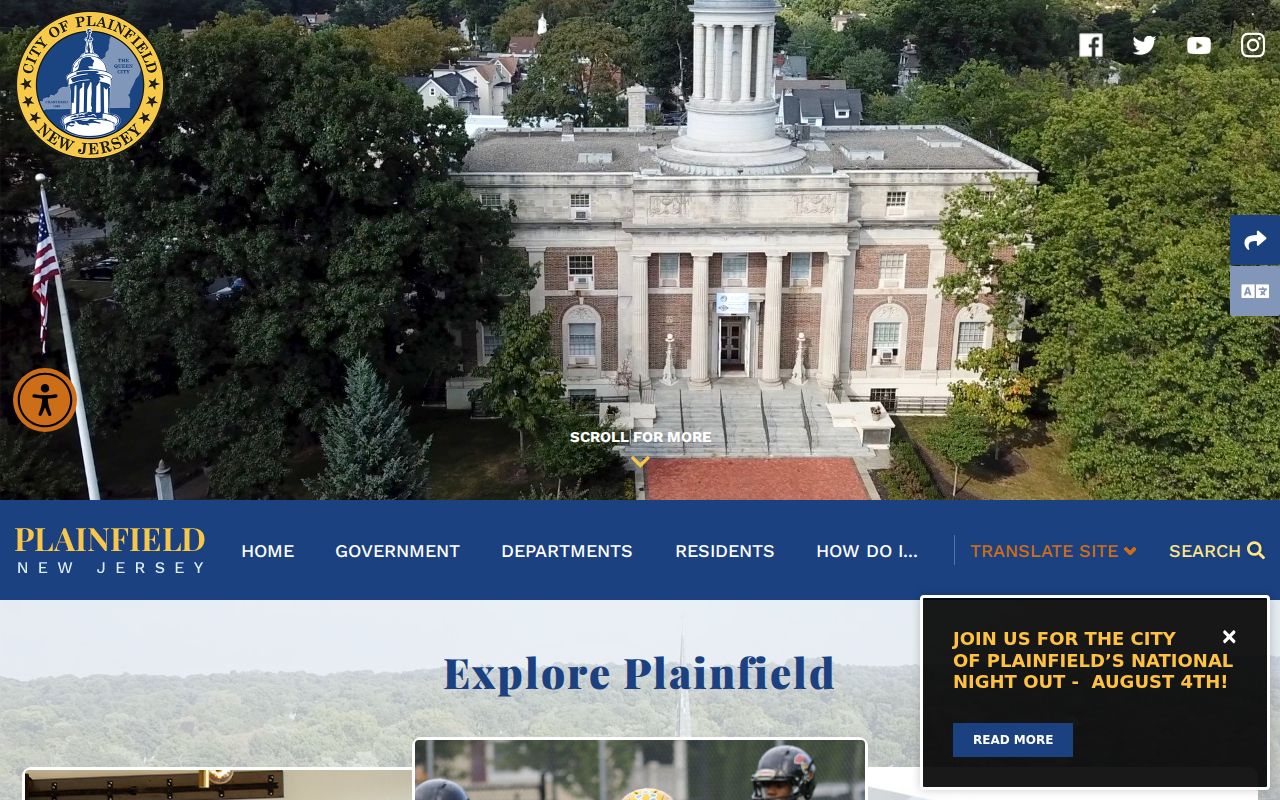
The city setting is a reminder that Plainfield's police custodian remains distinct from Union County offices. Confirm the badge agency or report header before filing, especially when the event occurred near a municipal or county line.
Plainfield Record Access Rules
Use OPRA for identifiable Plainfield agency records and Court Rule 1:38 for municipal or Superior Court files. Criminal-investigatory material may be exempt, but listed basic information about crimes, arrests, and charges remains available under N.J.S.A. 47:1A-3(b). Juvenile, victim, medical, active-investigation, sealed, and expunged material can be withheld or redacted.
Key Statutes:
Open Public Records Act, N.J.S.A. 47:1A-1 et seq. covers identifiable Plainfield government records, exemptions, response rules, and lawful charges.
N.J.S.A. 47:1A-3(b) requires specified basic facts about a crime, arrest, and charge even when other investigative content is exempt.
New Jersey Court Rule 1:38 governs public access to court records and lists protected categories.
Ask for a defined Plainfield record and accept lawful redaction. If a city response points to a different custodian, use the incident number to reroute the request rather than widening it into “everything” about a person.
Plainfield Record Corrections After Court
A Plainfield arrest can remain in the police and fingerprint record even when the municipal complaint is dismissed. Dismissal is the court outcome, not an automatic deletion command. Eligible records may be isolated through New Jersey expungement under N.J.S.A. 2C:52-1 et seq. An expungement order can cover police, court, BCI, and NJSP records identified in the petition.
If your own SBI history still shows an incomplete Plainfield arrest cycle, obtain the fingerprint-based Personal Record Request and the certified court disposition. Compare the legal name, aliases, arrest date, agency ORI, complaint number, and SBI number. Then use the official NJSP challenge or correction instructions. Do not ask Plainfield Police to rewrite a court judgment it does not maintain.
For an expunged matter that still appears locally, provide the order through the official custodian route. Union BCI executes expungement orders for its local files, while NJSP updates the statewide criminal history. Allow processing time, then recheck the systems appropriate to your own record.
Plainfield Crime and Record Counts
Police incidents, arrests, charges, and convictions are different measures. A Plainfield incident can result in no arrest. One arrest can produce several charges. Prosecutor screening can amend or dismiss a count, and the court can reach a different final offense. Raw police totals should never be presented as criminal-history or conviction rates.
For a public comparison, use a named year from official NJSP Uniform Crime Reporting or FBI Crime Data Explorer material, include the population denominator, and note reporting limits. Plainfield's urban form and population differ from nearby smaller municipalities, so a raw-count comparison can mislead. The same caution applies to record searches: a police hit establishes an agency file, while a conviction requires a final court disposition.
That distinction is practical. When a Plainfield result is used to understand a specific case, trace the event through the city report, the right court level, and the final judgment. Record the incident number, complaint or ticket number, and any later indictment number because each belongs to a different part of the file. A name-only match without those identifiers can join unrelated events. Verify the final status with the office that entered it. Do not turn an incident count into a claim about an individual.